Archivo de la categoría: English

The writer’s conclusion

Rembrandt – Belshazzar’s Feast. National Gallery (dominio público).

Some years ago, the magazine Inference invited me to respond to David Berlinski’s essay The Director’s Cut. I wrote the response in Spanish, and they kindly translated it into English. However, using Grammarly, I have now translated it according to my own taste, so I am publishing the English translation here on my blog.

The text discusses Gödel’s first incompleteness theorem (FIT). Berlinski spends nearly two-thirds of the text— which is not intended to be formally mathematical— explaining the idea Gödel used for the proof.1 Then, suddenly, he begins to talk about the implications of the theorem in the philosophical discussion about whether the mind is merely a computer or something more, the so-called «Gödelian argument.»2

In fact, the writing has an engaging and rather formal flow until the explanation of Gödel and Tarski. When it turns to the mind-machine problem, the mathematical depth is relegated (because the topic is no longer as mathematical but more philosophical), and it is almost as if a new writing begins, perhaps also engaging, but in a different direction.

It was the composition that struck me as most strange in Berlinski’s essay. First, after reading it several times, it remains unclear to me whether the mention of the mind-machine problem was merely a parenthetical comment or if it was the point the author intended to make. Second, the final section of the essay, also called «The Director’s Cut,» can be read in both ways, as a conclusion that encompasses the mind-machine problem or as a general reflection on what the FIT provokes, that has little or nothing to do with the Gödelian argument.

Thus, although I immensely enjoyed Berlinski’s explanation of the FIT demonstration, since I have little to add, I will focus on his insights regarding the mind-machine problem and his conclusion.

Unease for the modern man

It must be conceded that, in the most formal sense, it is difficult, based on Gödel’s incompleteness theorems or one of their corollaries, to conclude that the mind is more than a machine. From the statement «A formal system is consistent if and only if it has undecidable propositions,» as Hillary Putnam stated, not much more can be said.

However, it cannot be denied that there is something provocative in the incompleteness theorems that leads one to think that the human mind is more than a machine. Whether this point can (or cannot) be deduced from the theorems is not as interesting to me as how evocative they are in this direction. There is something in the incompleteness theorems that at least invites us to question whether the mind is merely a machine.3 Berlinski cites Gödel on this twice, which demonstrates that even Gödel could not escape the question. And even though Gödel’s response seems more like an application of his own result, thus giving the problem a certain air of undecidability, what is important here is that, even by his own questions, it is clear that there is something in the theorems that leads us to consider the matter.4

Is it that, as John Lucas and Roger Penrose say, we can detect truths that the formal system cannot decide? Is it that we can see symbols and go beyond the signs, something that computers (as we define them today) cannot do? It does not matter much; the point is that, with something in the theorems that leads to going beyond mechanistic views, the modern ideal is already the big loser.

Tekel

It is a common belief that mathematics is devoid of paradoxes and possible contradictions. Nevertheless, paradoxes have been discovered for centuries. When Bertrand Russell and Alfred North Whitehead published their Principia Mathematica, they aimed to free mathematics from them.5 The spirit of the times had everything to do with it. Modernity exalted reason above all else, so logical reasoning had to be reliable. The illuminated Enlightenment was contrasted with the obscurantist Middle Ages, and this had to be transparent to everyone. Comte, Russell, Wittgenstein, the Vienna Circle, and the Hilbert program are all points that sought to converge toward logical positivism.

Knowledge, to be regarded as such, must be subject to reason, and this must be done with strictly logical criteria. Gödel, with his theorems, undermines this ideal: there are true propositions that we are aware are true but that are beyond the reach of the formal system. Lucas and Penrose are correct about this. While it is true, as Putnam said, that the FIT viewed from the inside says nothing, it is also true that, when viewed from the shore, we see true propositions that the system cannot find. Perhaps this was Berlinski’s intention when he explained in detail the path of the proof up to Gödel’s definition 46, Bew, because, as he says: «Looking at his own film, the director is now able to see himself watching his own film.»

Gödel eliminates the modern ideal. While his FIT does not strictly prove that the mind cannot be reduced to a machine, it throws open the door to consider it as something more, and it also ends any pretense of subjecting all knowledge to a series of logical steps. The big loser is modern positivism in all its forms. Modern science was supposed to demonstrate beyond any doubt that the mind was reducible to a mechanism. Not only has it failed to do so, but Gödel leads us to question this postulate. The FIT leaves a the mouth of the modern man with a uncomfortable sense of tastelessness: it asserts that a formal system is either consistent or complete, but not both. It would be desirable to have both, but if one cannot have both, at least it is preferable to sacrifice completeness rather than consistency. So, we still hope that the system will be consistent.

Of Terence Tao and Edward Nelson

In 2011, the late Edward Nelson, a renowned mathematician from Princeton University and a former member of the Institute for Advanced Study, announced that he had demonstrated the inconsistency of arithmetic. The matter gained attention on social media when John Baez posted it on the blog The n-Category Café. Though Baez stated in the original blog that Nelson’s result was too technical for him to follow, Terence Tao and Nelson had a fascinating conversation in the blog’s comments on the same day.

Perhaps what caught the attention of all the mathematical nerds following the news at the time was that Tao, the mathematician who is considered by many to be the Carl Friedrich Gauss of our times, had to intervene on social media to clarify the matter. This demonstrated the importance of the discussion.

A not-so-small part of me, I confess, began to shift from fascination to morbid curiosity. What would happen if Nelson’s result held? What would be the mathematical implications? What part of arithmetic would remain intact? Which of our rational arguments would still stand?

But the excitement lasted little for me. In the back-and-forth of the conversation between Tao and Nelson, the former found a flaw in the latter’s proof, and Nelson ended up retracting. Nevertheless, something became clear to me: despite the vast majority believing, without having read the proof, that Nelson was wrong, the possibility that he was right remained open, and the confusion witnessed that day spoke louder than words. Baez:

Most logicians don’t think the problem is “making a consistent arithmetic” – unlike Nelson, they believe the arithmetic we have now is already consistent. The problem is making a consistent system of arithmetic that can prove itself consistent… Nelson doubts the principle of mathematical induction, for reasons he explains in his book, so I’m sure his new system will eliminate or modify this principle… Needless to say, this is a radical step. But vastly more radical is his claim that he can prove ordinary arithmetic is inconsistent. Almost no mathematicians believe that. I bet he’s making a mistake somewhere, but if he’s right he’ll achieve eternal glory.

Baez was right: Edward Nelson made a mistake in the demonstration and retracted it. However, despite the fact that Nelson’s first attempt at proof fell through in 2011, he continued to work on the matter until he died in 2014. During this period, he produced two works entitled Inconsistency of Primitive Recursive Arithmetic and Elements, which were uploaded to arXiv posthumously. Both contained an identical epilogue written by Sam Buss and Terence Tao. «Of course, we believe that Peano arithmetic is consistent; therefore, we do not expect Nelson’s project to be completed according to his plans,» the two mathematicians wrote at some point in the epilogue.

In the two parts where Baez uses the verb to believe in his citation, the emphasis is my own, as in the citation of Buss and Tao. In both comments, the use of the verb could not be more appropriate. Given the impossibility of showing that a formal system satisfying the conditions of the incompleteness theorems can be both complete and consistent, the only solution is to accept whatever we accept about consistency by faith. Faith is the most important of the mathematician’s and logician’s tools. It makes no sense for the mathematician to develop mathematics if he believes that the system is not consistent, but this consistency is something that he cannot know, only believe to be true at most.

The writer’s conclusion

Modern science was supposed to move from religion to logical knowledge. Still, Gödel’s second incompleteness theorem (SIT)—which shows that even if a system is consistent, it cannot prove its consistency—leads us to the conclusion that mathematics, our most formal form of knowledge, cannot be based on logic, so continuing to accept it requires faith. Poor Comte.

“No formal system can explain itself. It cannot state anything, and we cannot say everything,” says David Berlinski in the conclusion of his writing. Berlinski stops at the FIT, at undecidability.6 It’s fine; there was no need to go further to the SIT, a result he only mentions in passing once. However, it would have been useful for him to reinforce the fact that we cannot say everything. The hope for consistency has turned into uncertainty. The tastelessness of the FIT has turned into bitterness with the SIT. The best we can aspire to is to have no certainty of consistency because once we prove that the system is consistent (or that it is not), we will have merely demonstrated its inconsistency.

Indeed, the formal system cannot explain itself. Furthermore, as Berlinski said, it cannot say anything. Put another way, from the perspective of SIT once again, it can say many things, but none will be definitive. How do we know that some Edward Nelson does not emerge with a working demonstration that arithmetic is inconsistent in the future?

A few days ago, the writer Arturo Pérez-Reverte, a fellow of the Royal Spanish Academy, published the following thread of three tweets, which I translate here in full:

Before going to sleep (I just returned from a trip), I leave you, or I propose, an idea that has been in my head for a long time: the perfect and impossible novel, in case any of you is truly gifted (as there must be someone) and feels inspired to write it.

Write a novel whose last page is identical to the first and compels readers to return to the first page so that the new reading of the book, in light of what has already been read, provides a different experience. And dedicate the novel to Borges.

Good night.

The perfect novel that Pérez-Reverte dreams of will have to be based on Gödel’s incompleteness theorems. After all, the crux of Modernity has left us as we began: it is not just that we cannot decide; it is that even our most formal systems require faith. Just as it was before Modernity. The last page of history does not differ from the first, but it does compel us to read anew, “[the incompleteness theorems] have changed the way we see things.”7 Before Modernity, we sensed that we had no way to ground reason outside of faith. Now we know.

There is only one novel. All the others are just derivations of Don Quixote. A tribute to Borges

Notes

  1. Dan Gusfield, from the University of California, Davis, has a test in the ‘Goldilocks zone’ that is neither too formal to become incomprehensible to the average person nor too relaxed to become superficial. It is suitable for second-year undergraduate students. The written version is here, and the video version is here.
  2. Philosophers refer to this discussion as the «Gödelian argument in the mechanistic conception.» It is a long and tedious name.
  3. And that something, by the way, is not questioned by computers.
  4. In a writing by Jack Copeland, also cited by Berlinski, it states that Gödel seemed to lean more towards immaterialism. The Spanish Wikipedia entry on Gödel’s incompleteness theorems also affirms this: «[Marvin] Minsky has reported that Kurt Gödel told him in person that he believed humans have an intuitive, not just computational, way of reaching the truth and therefore his theorem does not limit what can be known as true by humans.» Unfortunately, Wikipedia does not provide any references.
  5. For example, see this talk by Douglas Hofstadter.
  6. And in the concept of truth in formalized languages of Tarski.
  7. Berlinski, The Director’s Cut

Witness and intelligence

“If I testify about myself, my testimony is not true” (John 5:31)

These words of Jesus surprised me a few days ago, my son. They caught my attention for at least two reasons: my Lord’s humility and its stark contrast with the world.

As for the latter, the people of the world live by promoting themselves. Particularly in academia and in the United States, this is overblown (although Mom, who knows the Colombian corporate world very well, tells me that it is not different there). There are too many people around me of meager talent whose only virtue to reach success has been their ability to sell their name. If it is annoying to see a capable person promoting himself, you will soon realize how unpleasant it is to see an incapable person climbing the ladder just because he sells himself well.

This is where my Lord’s humility comes as such a contrast. It is the Incarnated God Himself who is speaking here! The Second Person of the Trinity! The Son of God! The Son of Man! And yet He says that if he were to testify about Himself, His testimony would not be valid. Jesus changed the world and split human history into two without testifying of Himself. Instead, He bore witness to God the Father and, in His own words, He left it to the Father to bear witness for Him: “The Father who sent me has himself borne witness about Me.” Indeed, the four Gospels tell us that when Jesus was baptized, the voice of God the Father was heard saying from heaven, “This is my beloved Son, with Whom I am well pleased” (see, e.g., Matthew 3:17).

Who are we going to follow? I admit that I promoted myself many times. But for us who have decided to follow Christ, believe in Him, and imitate Him, the only option is not to give glory to ourselves but to our God. Therefore, this is the criterion to use from this point on: if what I am going to say is to praise myself, it is wrong; if what I am going to say bears witness to our good God, it is worth it.

To round out the matter, I was also reading Deuteronomy 4: 5–6:

See, I have taught you statutes and rules, as the Lord my God commanded me, that you should do them in the land that you are entering to take possession of it. Keep them and do them, for that will be your wisdom and your understanding in the sight of the peoples, who, when they hear all these statutes, will say, ‘Surely this great nation is a wise and understanding people.’

Let me be absolutely clear about this: the Mosaic law is not for believers to fulfill. However, the written word in the old covenant is a type of the Word made flesh in the new one (Hebrews says that the law is a shadow of the good things to come, not the very presence of these realities), namely of Jesus, the Logos. What this means is that, although we are not called to fulfill the law of Moses, the attitude that the old covenant asks of the people of Israel with respect to the law is the attitude that we are to have with respect to the words of our Lord Jesus Christ.

Thus, the equation is clear: if I obey and practice the words of my Lord, He—not I, but He—will show my wisdom and understanding to others. Well, I am not looking for recognition anymore (it just took me 40+ years to figure this out!), but I feel great peace by knowing that my life is in God’s hands. What is important to me is that the words of Jesus have an unequivocal message: it does not matter that I live in an academic environment where appearing smart is seen as an asset because it’s not about selling myself; it’s about giving glory to Him.

I have been looking for a new job for three years and have deeply longed to change the one I now have, but the end does not justify the means. If change is going to happen, let it be in God’s way so that it will be worth it for eternity. If not, I am not interested.

Plenitude

The kiss – Gustav Klimt

I began to feel depressed in the middle of my Ph.D., around the year 2007. The difficult financial situation of my family in Colombia, a troubled romantic relationship, and my almost total inability to survive on my own (which became too evident when I had to live without my family in Brazil) took a toll on me, and the bill lasted for approximately ten years.

When I came to the States, loneliness hit even harder. When I started my postdoc, I realized that all my dreams came true but I was still unhappy. Furthermore, I realized that accumulating more success wouldn’t bring the happiness I longed for, so I ended up paralyzed. I was angry with God; on the brink of suicide, I really wanted to die, and I hated my intelligence because it made me feel even worse about myself. After never fearing anything, I became terrified of the night; around 4:00 pm, the panic of knowing it would get dark, and I would be alone again overwhelmed me. How was it that, for everyone who saw me, I had so many talents, and I was sinking?

My Google Scholar clearly reflects it: after completing my doctoral dissertation in 2009, which produced two articles (this and this), I only published again in 2017, eight years later! Google Scholar shows two more articles, but they are somewhat misleading (one is a preprint that couldn’t be published due to an error in the argument, and the other was an article from my undergraduate thesis to appease my employer in 2016).

2017 was a turning point in my life. The lowest point I touched and the point from which my God rescued me. After my most sincere prayer of repentance, I had a personal encounter with Christ that transcended everything I previously believed and understood. I used to talk a lot about religion. I gave lectures throughout the Spanish-speaking world on the existence of God, some of them for thousands of people, but I had never had an encounter with Christ in my adult life. Like Job, I can say:

I uttered what I did not understand,
things too wonderful for me which I did not know…
I had heard of you by the hearing of the ear,
but now my eye sees you.

My best analogy to describe what happened is this:

John Doe has read everything about the kiss: the best psychology books about its emotional effects, the best biological and medical literature on its physiological effects, and the best poems, novels, and stories — the romantic ones, the erotic ones, and the worldly ones. There is no greater expert on the kiss than John Doe! When he talks about it, everyone listens because he is the authority. But John Doe has never kissed the woman he loves. Perhaps he has kissed others, maybe many, but not the one he loves.

After many years, when he finally kisses her for the first time with an endless kiss — just the two of them, without impediments or haste—and the only words that come to his mind are: «Thank you, my God! Thank you, my God! Thank you, my God! Thank you, my God!», then he realizes that he did not know what a kiss was, and that he could never express in words the existential plenitude he experienced.

Furthermore, he now realizes that it doesn’t matter if his ideas about kissing were true or false because they do not add or take a thing. They weigh nothing! Like a null set, all his opinions were tekel. Theory and words fall so short that to say they do no justice to reality is to do no justice to reality. After having all his works written, when Thomas Aquinas had a mystical revelation of God, he summarized it well: «I can write no more. All that I have written seems like straw.» In that sense, I declare myself a Thomist!

From that point on, the guidance of the Holy Spirit became as clear to me as the purest water; his voice took away all my fears, and the sadness left me, never to return. In 2018, during a time of prayer and fasting, God promised me that from my 40s on He would restore everything I lost. He also promised He would give me a wife. And so it was. When I was 40, I met Lisette in Medellín. Two days after we started talking, I told her that I wanted to marry her, and she accepted. A month before turning 41, with full certainty in my heart that God had fulfilled his promise, we were already together in Miami. My good God fulfilled His word and has not stopped fulfilling every promise He has made since then. He has restored every single area of my life.

What about my profession? One of the things God took away was my mental block. In 2018, I started generating ideas again. The ideas gradually materialized into articles, and since then, I have been publishing in such diverse areas and in such well-reputed journals that I am still amazed: philosophy, physics, epidemiology, population genetics, statistics, information theory, and artificial intelligence, are but a sample. And I have more ideas. Many more! So many that sometimes it’s hard for me to pick the one to dedicate my next effort. And I know greater things are coming. After a mental and existential hiatus of ten years, there is no area where God has not intervened to restore it and make all things new. And yes, my Google Scholar page is there to prove it.

I don’t believe in religions; I don’t think the answer is Catholicism, Protestantism, or Anglicanism; in fact, I have a rather poor — if not negative — view of all those «isms.» They all seem like distractions from the true goal. I believe in Jesus; I talk about Jesus and what He has done for me. I live for Christ, and I follow Him. Like Saint Paul, I have been crucified with Christ; it is no longer I who lives, but Christ lives in me; and what I now live in the flesh, I live by the faith in the Son of God, who loved me and gave Himself for me. Like Saint Augustine, my heart was restless until it found rest in Him. Like Saint Thomas, everything I did before finding Him seems like straw. Like William Wilberforce, I believe God called me for a purpose greater than I can imagine. Like George Müller, I decided to die to myself to live for Him, and I want to show the world that it is worth the price.

Legacy

C. R. Rao is a very famous statistician who is more than one hundred years old by now. He is perfectly lucid and, being no fool, knows that his tenure in this earthly life will soon come to an end.

He has many impressive achievements. A gifted student and, by some serendipity, being in the right place at the right time, he was mentored in Cambridge by Sir Ronald Fisher, the father of modern statistics. Afterwards, he himself would become a mentor to many excellent mathematicians. He developed and proved very important results, many of which bear his name and are used by millions in every field of knowledge. Few among us could say we have accomplished as much as he has. However, he is now worried that once he passes away his work will be forgotten. 

And I cannot blame him. I do sincerely understand him.

Most of us will be left to human oblivion about three generations after we live. Few, like our famous statistician, will escape anonymity beyond that point. Among the few, only a handful will be remembered by all future generations. Moreover, our planet, our solar system, and our galaxy are all going to collapse at some point;  even our universe will die out cold in a state of maximum entropy, as the second law of thermodynamics tells us, if it is a closed system. Therefore, if there is no more to life than this earthly life, all of us will be forgotten. Regardless of how much good (or evil!) we have done, it will all be forgotten. And, worse yet, nothing that we did will ever matter. Nothing at all. Not a thing.

Ecclesiastes, the Old Testament book, discovered this reality thousands of years ago; atheistic existentialism, less than one hundred years ago, rediscovered it too. We humans, finite as we are, but with longings for eternity, need something that goes beyond death or death will catch us soon. If there’s nothing more to life than this world, we are hopeless.

Now, we can believe the philosophy that there is nothing beyond and, being coherent enough, to embrace the meaninglessness that comes with it. Or we can accept our instincts of transcendence, of eternity, and believe that there is something else —that we do not live in a closed universe, and there is a bigger reality than this world. Concededly, the two options have to be accepted by faith. But as C. S. Lewis put it, given that all our human longings can be satisfied, “if we find ourselves with a desire that nothing in this world can satisfy, the most probable explanation is that we were made for another world.” So the longing for eternity betrays those who deny that there is a bigger reality and that it makes our lives meaningful.

Then, for our world to matter it is a necessary condition that there must be a God who made us in His image, which will in turn explain why we have this longing for eternity. Nonetheless, if there is a God beyond our universe, we cannot grasp Him (for the same reason we cannot prove the existence of a multiverse) unless He comes to us and takes us to Himself. That which is finite can never reach infinity, but it is very easy for the infinite to reach what is finite without losing its infinitude.

The good news is that this is exactly what Jesus Christ accomplished! He, being in the form of God, became one of us and came for us, so that we could live with God in eternity. He who is Infinite became finite to take that which is finite to infinity with Him.

Life has no meaning if there is no God. And if there is a God, perfect as He is, we who are imperfect cannot reach him unless He first reaches us. That is why Christianity makes so much sense. That is why Christ is the only way to God. If God, our existence does matter. And if Jesus Christ, we infinitely matter in a personal and existential way, as our instincts rightly advise us.

Since we cannot do anything to reach Him, our only option is to receive by faith what He did for us. That’s all. Just believing. Believing in our hearts that He is the Son of God who came to give His life for us, but was raised from the dead to take us with Him to God the Father. Nothing else is required, and yet everything is offered.

Eternity

Eternity cannot be defined in terms of time, because time began to exist with this finite universe. Were we to define eternity in terms of time, we would need to give God a beginning, so that this entity we call God in reality would not be it; instead, it would be becoming more God as time goes by, as in the questionable “process theology.” Eternity must be something different. I say eternity is the plenitude that is experienced in a relationship of love. That is why God needs to be Triune in order to be eternal —the eternity of each of the three Persons in the Trinity would reside in the perfect relationship of love —given and received— they have with the other two.

Likewise, the eternity we long for, that which God placed in our hearts, must be of an intimate relationship of love with Him. In this way, nothing else, no one else, is able to satisfy such a longing, except the One who can love perfectly. Just Him.

But we are not there yet. However, in the meantime, the better our relationships of love here, the closer we will be to plenitude in this world. Maybe they are not going to be perfect, but it does not make them bad or less desirable. Everything that is finite is only small when compared to infinity. In this sense, no human relationship, no matter how loving, resembles having a relationship with God —the relationship with God there. Nonetheless, that which is finite can be large, very large, when compared to other finite things. Therefore, the more we come close to plenitude in our relationships of love here, the closer we will be to eternity, in a limit that is only going to converge eternally with Him there.

Meanwhile, we love here. We offer eternity —the eternity that God has set in our hearts— to those who are close to us here. And we do it not only with the hope that each of us is going to experience the eternity of His love there, but with the hope that our relationships of love here will be perfected there, and that, in Him, those relationships will also become eternal.

Of Hilbert and Gödel

It was the year 1900; August, to be more accurate, when in Paris, David Hilbert, one of the best-known mathematicians of his time, posed a list of twenty-three open problems. The impact was huge, so much so that much of the mathematical research of the dawning century was consumed by these problems, the most important ones for Hilbert. Nobel Prize winners, Fields medalists, and other winners of prestigious awards were among those who work to solve them. Some of them (the Riemann hypothesis, for instance) are so hard that they are still open, and large sums of money are offered to whomever is able to solve them.

It was the year 1900. The Enlightenment had come, the Dark Ages were past. The Scientific Revolution brought progress. God was dead, now the Superman (Nietzsche’s Übermensch) lived. The universe with its infinite history did not require a God. Darwin had proposed a mechanism through which all biological species have merely emerged. The twentieth century was shaping up as the most promising one. It would be the beginning of a new age in which man will take the position he was destined to take, far from the noise of all those meaningless myths. Reason should be able to explain all things. Each event should have a natural explanation for its occurrence. Every proposition should be subjected to a logical explanation to verify its truth value. If every new year brings with itself the happiness and hope of a new beginning, how much more must a new century bring! And how much more must the twentieth century, the first truly Modern century through and through, promise! No wonder such a fervor.

In a way the optimism was at least understandable, if not justified. Not even Hilbert could escape the enthusiasm of the times. Two of his twenty-three problems, the second and the sixth, reflected the modern aspiration of subjecting everything to human reason. The second problem was to prove that the axioms of arithmetic were consistent —that the axioms of the natural numbers did not lead to any contradictions. The sixth problem was to axiomatize physics, particularly probability and mechanics.

The sixth problem conveys Hilbert’s modern heart: physics should be subjected to cold reason, even chance must submit to reason! Mathematics, the most rigorous way of knowing, should extend itself beyond abstraction to dominate chance and physical reality. He put the matter this way when he posed the second problem:

When we are engaged in investigating the foundations of a science, we must set up a system of axioms which contains an exact and complete description of the relations subsisting between the elementary ideas of that science. The axioms so set up are at the same time the definitions of those elementary ideas; and no statement within the realm of the science whose foundation we are testing is held to be correct unless it can be derived from those axioms by means of a finite number of logical steps…

But above all I wish to designate the following as the most important among the numerous questions which can be asked with regard to the axioms: To prove that they are not contradictory, that is, that a finite number of logical steps based upon them can never lead to contradictory results.

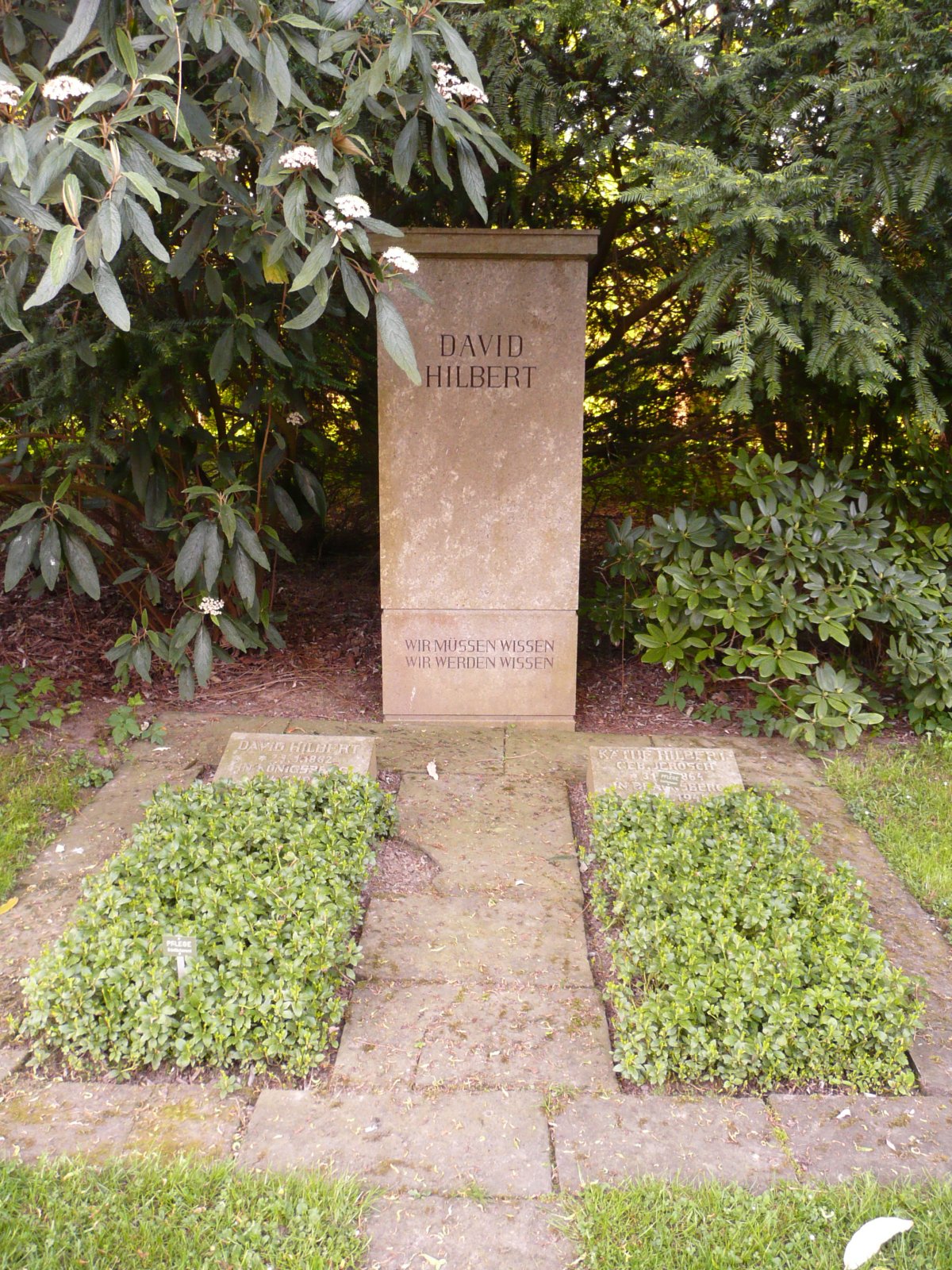
Hilbert was a modern man, no doubt about it. He wanted all of scientific knowledge to be obtained from basic axioms ‘by means of a finite number of logical steps.’ His goal was an extension of his particular dream for mathematics, the eponymous Hilbert’s program —to establish a consistent and complete finite number of axioms as a foundation of all mathematical theories. The goal was of cardinal importance to him. To the point that the his gravestone at Göttingen has these words inscribed (in German):

We must know.
we will know.

Hilbert epitafio
Image by Kassandro, CC-BY-SA-3.0

The epitaph on the gravestone was his response to the Latin maxim ignoramus et ignorabimus («we do not know, we shall not know»), a dictum pronounced by the German Physiologist Emil du Bois-Reymond in a speech to the Prussian Academy of Sciences in which du Bois-Reymond argued that there were questions that neither science nor philosophy could aspire to answer. 

Seen from the perspective of the age, what C. S. Lewis called ‘climate of opinion,’ Hilbert’s aspiration was understandable. The two World Wars had not happened yet; science had not been used to create biological weapons; no one knew that the twentieth century will become the bloodiest in history; progress and industrialization had not caused widely noticed environmental issues; the Left had not produced its Gulag and the Right had not built its Auschwitz.

These events (and some others) overthrew the modern ideal in the way the rolling stone in the vision of Daniel broke the statue with feet of clay into pieces. And in all of these events the problem was easily singled out —the human being. It is impossible to make a Superman out of a man. Enlightened modernity, blinded by pride, failed to see what all religions, even the oldest and the false ones, have seen so clearly —that man is wicked and the intention of his thoughts is only evil continuously, that from the sole of his foot even to the head there is nothing sound in him, that man’s heart is deceitful more than any other thing. In brief, that the problem of man is no other than himself.

Thus, the practical problem of Modernity was man himself, and it was devastating. But the conceptual problem was still to come and it was equally devastating to the modern aspirations.

Enter Gödel

It was September 8 of 1930, Monday, when Hilbert opened the anual meeting of the Society of German Scientists and Physicians in Königsberg with a famous discourse called Logic and the knowledge of nature. He ended with these words:

For the mathematician there is no Ignorabimus, and, in my opinion, not at all for natural science either… The true reason why [no-one] has succeeded in finding an unsolvable problem is, in my opinion, that there is no unsolvable problem. In contrast to the foolish Ignorabimus, our credo avers: We must know, We shall know.

In one of those ironies of history, also in Königsberg, during the three previous days to the conference opened by Hilbert’s speech, a joint conference called Epistemology of the Exact Sciences also took place in Königsberg. On Saturday September 6, in a twenty-minutes talk, Kurt Gödel presented his incompleteness theorems. On Sunday 7, at the roundtable closing the event, Gödel  announced that it was possible to give examples of mathematical propositions that could not be proven in a formal mathematical axiomatic system, even though they were true.

The result was shattering. Gödel showed the limitations of any formal axiomatic system in modeling basic arithmetic. He showed that no axiomatic system could be complete and consistent at the same time.

What does it mean for the axiomatic system to be complete? It means that, using the axioms given, it is possible to prove all of the propositions concerning the system. What does it mean for the axiomatic system to be consistent? It means that its propositions do not contradict themselves. In other words, the system is complete if (using the axioms) all proposition in the system can be proven either true or false; and the system is consistent if (using the axioms) no proposition in the system can be proved simultaneously true and false. 

In simple terms, Gödel’s first incompleteness theorem says that no consistent formal axiomatic system is complete. That is, if the system does not have propositions that are true and false simultaneously, there are other propositions that cannot be proven either true or false. Moreover, such propositions are known to be true but they cannot be proven using the system axioms. There are true propositions of the system that cannot be proven as such, using the axioms of the system.

Gödel’s second incompleteness theorem is stronger. It says that no consistent axiomatic system can prove its own consistency. In the end, his second theorem entails that we cannot know whether a system is consistent or not; we can only assume that it is.

Implications for Hilbert’s program

Let’s recall a portion of Hilbert’s enunciation of his second problem:

[N]o statement within the realm of the science whose foundation we are testing is held to be correct unless it can be derived from those axioms by means of a finite number of logical steps.

Hilbert knew the difference between science and mathematics, of course. So this introduction to his second problem actually fits well to his sixth problem —to axiomatize science. In this regard, his sixth problem is more ambitious than the second one because it purports to translate to science —beyond mathematics— what mathematics should be doing… at least in Hilbert’s mind. But inasmuch as Hilbert was broadening his concepts to take in science as well as mathematics, it was of particular importance that his statement be true of mathematics. That is, the word «science» should be replaceable by the word «mathematics»:

[N]o statement within the realm of the mathematics whose foundation we are testing is held to be correct unless it can be derived from those axioms by means of a finite number of logical steps.

But Gödel’s first incompleteness theorem voids such a statement. There are indeed true mathematical propositions that cannot be derived from a finite number of axioms through a finite number of logical steps. Mathematics, our best way of knowing, the one we consider the most certain, is, in the most optimistic case, incomplete! 

But even this is not the end of the matter. Returning to Hilbert’s presentation of his second problem, he says this in his second paragraph:

Above all I wish to designate the following as the most important among the numerous questions which can be asked with regard to the axioms: To prove that they are not contradictory, that is, that a finite number of logical steps based upon them can never lead to contradictory results.

Well, Gödel’s second incompleteness theorem destroys this statement too. Because it proves the opposite: it shows that no consistent formal axiomatic system can prove its own consistency. If Hilbert’s program is the Titanic, Gödel’s incompleteness theorems are the iceberg that sunk it.

Moreover, Gödel’s first incompleteness theorem throws Comte’s positivism into the trashcan and it does the same with today’s «scientism». There are indeed true statements that are beyond mathematics and science.

Faith

Gödel’s second incompleteness theorem is really strong, overwhelming, and even a source of hopelessness from a rationalist viewpoint. If no consistent formal system can prove its own consistency, the consequences are devastating for whomever has placed his trust in human reason. Why? Because provided the system is consistent, we cannot know it is; and if it is not, who cares? The highest we can reach is to assume (which is much weaker than to know) that the system is consistent and to work under such assumption. But we cannot prove it, it is impossible!

In the end, the most formal exercise in knowledge is an act of faith. The mathematician is forced to believe, absent all mathematical support, that what he is doing has any meaning whatsoever.  The logician is forced to believe, absent all logical support, that what he is doing has any meaning whatsoever. 

Some critics might point that there are ways to prove the consistency of a system. For instance, provided we subsume it in a more comprehensive one. It is true. In such a case, the consistency of the inner system would be proved from the standpoint of the outer system. But a new application of Gödel’s second incompleteness theorem tells us that this bigger system cannot prove its own consistency. That is, to prove the consistency of the first system requires a new faith step in the bigger one. Moreover, since the consistency of the first system depends on the consistency of the second one —which cannot be proved— there is more at stake if we accept the consistency of the second one. Now suppose there is a third system which comprehends the second one and proving that the it is consistent. Faith is all the more necessary if we are to believe that the third system is also consistent. Faith does not disappear, it only compounds making itself bigger and more relevant in order to sustain all that it is supporting. 

In the end, we do not know whether the edifice we are building is going to be consistent, we do not have the least idea. We just hope it will be, and we must believe it will be in order to continue doing mathematics. Faith is the most fundamental of the mathematical tools.

The question is not whether we have faith, the question is what is the object of our faith. It is the rationality of mathematics what is at stake here, its meaning. But we cannot appeal to mathematics to prove its meaning. Thus, Platonic reality, given its existence, does depend on a bigger and more comprehensive reality, one beyond what is reasonable, one that is the Reason itself. 

The pretense to know all things is nothing more than a statement on a gravestone. 

Postscript in Christian apologetics

Even though for years I enjoyed applying analytic philosophy to Christian apologetics, this and other considerations have led me to question that approach. At this point, I don’t see that it shows anything definite. Rather, I see it as a concession to the unbeliever in order to lead him to question his own faith and place it instead in Christ.

It is sad to see that many a Christian apologist has placed his faith in logic, not in the Logos. Minerva’s worshippers, rather than Christ’s. At the end of the day, logic does not prove anything because it is grounded in unprovable propositions. It is impossible to use Aristotelian logic to prove Aristotelian logic; it begs the question, to accept it requires faith. Axioms are indemonstrable by definition and, as theory develops, they become less and less intuitive; to accept them requires faith. Similarly, the consistency of any formal axiomatic system cannot be proven; to accept it requires faith. All of our knowledge is sustained by faith. All of it.

Sustaining faith in reason, besides making for a cheap faith, constitutes an unacceptable abdication to rationalism, because reason and logic cannot sustain anything. They cannot even support themselves. Moreover, in order for faith and reason to have a foundation, not only from an epistemological viewpoint but from an ontological one, there must be a something that sustains it —a First Sustainer undergirding them all.

There is no logic without a Logos. Faith’s only task is to accept that such a Logos does exist. The opposite is despair, meaninglessness. 

***

In the beginning was the Logos,
and the Logos was with God,
and the Logos was God.
He was in the beginning with God.
All things were made through him,
and without him was not any thing made
that was made.
In him was life,

and the life was the light of men…
And the Logos became flesh
and dwelt among us, 
and we have seen his glory,
glory as of the only Son from the Father,
full of grace and truth.
John 1:1-4, 14

He is the image of the invisible God,
the firstborn of all creation.

For by him all things were created,
in heaven and on earth,
visible and invisible,
whether thrones or dominions
or rulers or authorities
—all things were created through him
and for him. 
And he is before all things,
and in him all things hold together. 

Colossians 1:15-17